How to name an amount without awkwardness, what to answer to “how much do you want,” and how to rehearse the conversation with your manager.
A conversation about money almost never fails because of greed. It fails because of preparation: a person does not know their range, says the first number that comes to mind, and agrees to “we’ll think about it” instead of a concrete answer. The good news: this is a conversation with a predictable structure — it can be prepared for and rehearsed.

Behind the refusal to have the conversation is not laziness, but three specific thinking mistakes.
The first is overestimating the risk. In Francis Flynn and Vanessa Bohns’s study, people who asked for help systematically underestimated the likelihood of agreement: they expected about half of requests to be refused, but received agreement in approximately 90% of cases. The same works with asking for a raise: we see our awkwardness and do not see that for the manager the conversation is part of the job.
The second is conflating the act with the person. “I’m asking for more” turns into “I’m ungrateful and insolent.” In reality, you’re discussing not character but the terms of the deal: scope of work versus pay.
The third is the absence of a number. The most common reason for failure: a person comes without a specific amount and agrees to “we’ll name it later.” When you don’t have your own number, it’s easy to mistake someone else’s for the norm.
The argument “I work a lot” doesn’t work — it isn’t verifiable. Three types of facts do work:
If there are no changes, the conversation has no basis: first agree on new tasks, then on the money for them.
Before the conversation, you need three numbers, not one:
| Number | What is this | How to use |
|---|---|---|
| Minimum | the amount below which you do not agree | keep it in mind, do not say it out loud |
| Goal | a realistic market amount taking your contribution into account | state it first |
| Maximum | upper limit of the market range | for answering «and how much would you ideally like» |
Key rule: state the target, not the minimum. The minimum exists for you to understand when it is worth walking away from the conversation. If you state the minimum, bargaining will start below it.

Not «I need to talk about salary» (it sounds like a complaint), but a specific topic and time:
«I want to discuss my role and compensation. Over the past six months, I've taken on tasks X and Y, and I want to check how this is reflected in my salary. Is 15 minutes on Thursday convenient?»
One sentence, without apologies and without justification in the same phrase:
«I'm targeting a sum in the range from N to M. For me, this matches the scope of tasks I'm currently handling.»
A range is better than a single number: it shows that you know the market and leaves room for negotiation. But remember: the lower bound of the range is what you are actually willing to accept.
If the question came first, you have the right to turn it into an exchange of information:
“I’m ready to work with the range for the role. Tell me what range you had in mind for this position, and then I’ll give you a more precise figure.”
If they insist, name a number. Answering “I don’t know” or “whatever you decide” almost always leads to the lower end of the range.
The most common mistake is to fill the silence: “well, it could be less,” “if that’s too much, let’s discuss it.” After you have named the amount, finish your sentence and go silent. A pause is not a refusal; it is time to think.
| What they say | What to answer |
|---|---|
| «There is no budget right now» | «I understand. Let's pin down when the budget is reviewed and what needs to change for that amount to become possible». |
| «Everyone gets about that much» | «I can use the market as a guide: for similar roles the range is higher. I'm ready to show exactly what I cover». |
| «Let's come back to this in six months» | «Okay. Let's define the criteria: what results over that time will mean a review». |
| «You understand, this is a difficult period right now» | «I understand. Then let's discuss not only the amount but also the non-monetary part — schedule, tasks, training». |
General rule: don't argue with an objection, but turn it into specifics — a deadline, a criterion, a number. “No budget” without a date and condition is not an answer but a postponement.
Even with ready-made arguments, the first run-through of a conversation almost always goes off plan: your voice falters, your thoughts speed up, an awkward pause throws you off. This is cured by rehearsal — just like any other speech.
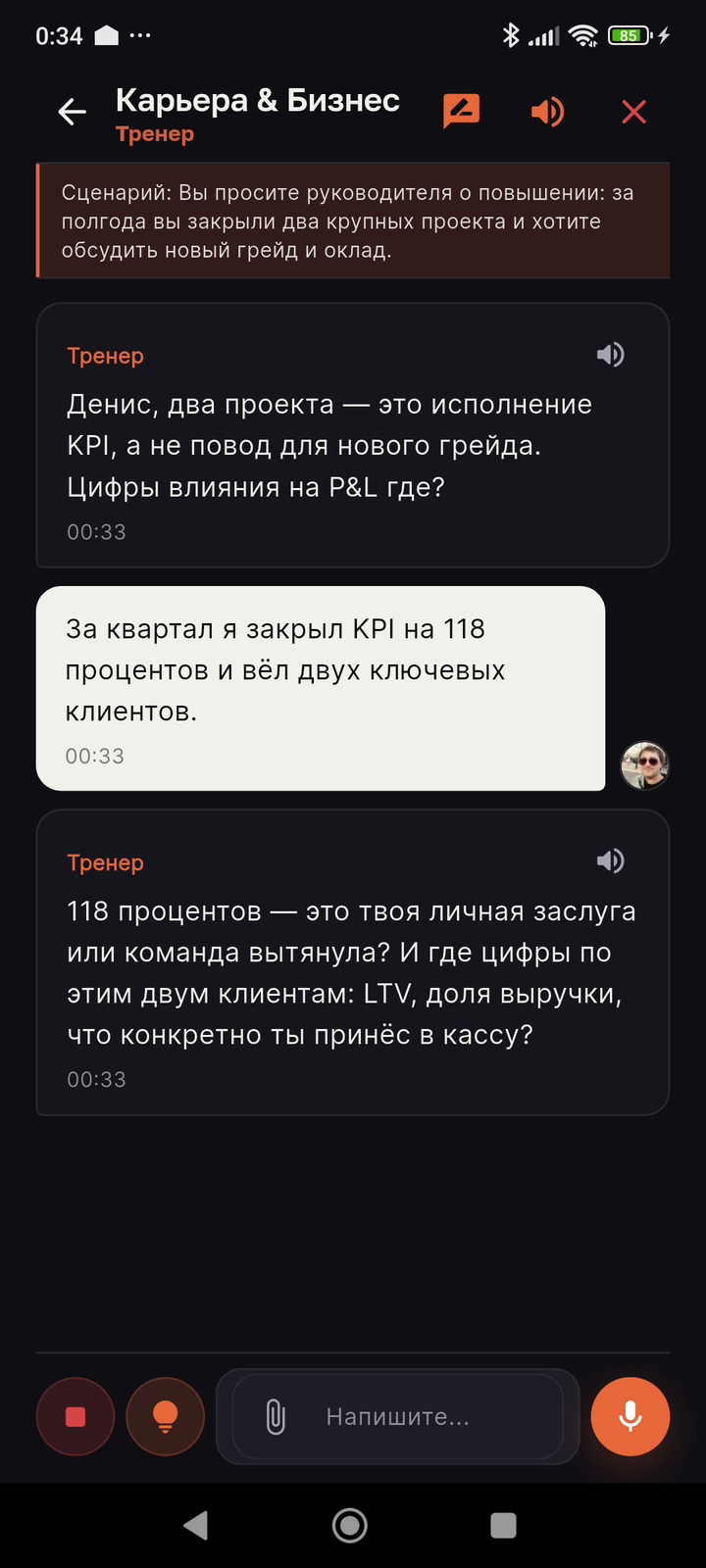
In HintMeTalk AI you can go through such a dialogue in full:
This does not replace preparation — it is its final step. Rehearsal does not guarantee a raise: the decision depends on the budget and company policy. It removes the part of the risk that depends on you: nervousness, pace, and the ability to hold a pause.
A refusal is not the end of the conversation if conditions are drawn from it. Three things worth recording before you leave:
It is useful to send a short email after the meeting: «Thank you for the conversation. To confirm: we will return to the issue in March, the criterion is closing project X and growth in indicator Y». This turns a verbal agreement into a verifiable one.
After a measurable result and before you start burning out — that is, immediately after a successful project or an expansion of responsibilities. Bad timing: when the company is cutting its budget, and having the conversation on emotion after a bad day.
If you know the market and have determined a range — yes, this sets the frame for the conversation. If you don't have the data, it's better to first clarify the range allocated for the position. The main thing is not to answer “whatever you decide”: this almost always means the lower bound.
Don't agree right away. Ask how the figure was calculated and whether there is a possibility of a review in 3–6 months with fixed criteria. Negotiation is not a single answer but two or three moves.
In the first months, it's premature to talk about money — results are needed first. A workable strategy: after 6–12 months, come with three measurable achievements and market data, not with the argument “I've been here a long time.”
Yes, and it's a normal part of the process. At the offer stage, you have the right to clarify the salary range, schedule, and terms. Refusing to discuss almost always means you'll accept the first offer — and the first offer is rarely the best one.
Bring the conversation back to facts and timing: “Let’s return to the numbers: what needs to change and when.” If emotions are running high, postpone the conversation rather than sorting out the relationship on the spot — what helps is a debrief of the conversation in a conflict.
Gather three numbers and three facts — that’s already eighty percent of success. The rest comes from rehearsal: open HintMeTalk AI, select the “Coach” mode, and describe the situation. One run-through of the dialogue before the meeting usually reveals what isn’t visible on paper: where you apologize, where you lose a number, and where you agree too quickly.
If an interview lies ahead, rather than a conversation with your current manager, start with interview preparation — it covers the questions and the structure of the answer. And if the request itself and saying no are difficult, this will come in handy: the article about guilt-free negotiations.
Practise this skill in HintMeTalk AI
Open the app HintMeTalk